
- Details
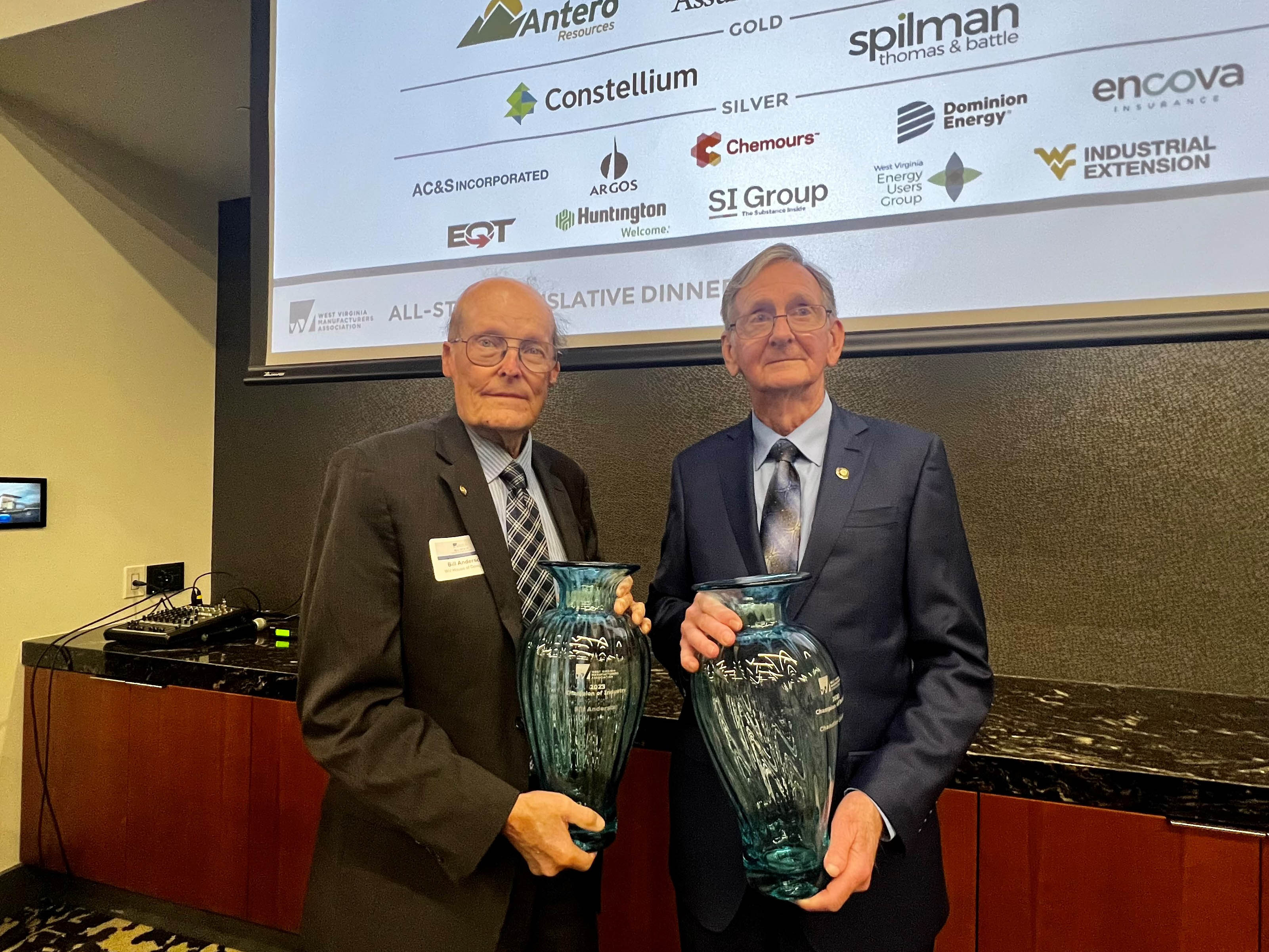
The West Virginia Manufacturers Association (WVMA) has recognized Sen. Chandler Swope, R-Mercer, and Delegate Bill Anderson, R-Wood, as the 2023 Champion of Industry Award recipients at its recent annual All-State Legislative Dinner.
The awards recognize their legislative leadership, outstanding contributions to the manufacturing sector and their unwavering commitment to advancing West Virginia's economic growth. WVMA President Rebecca McPhail said both legislators exemplify the dedication and vision required to foster a thriving industrial landscape in West Virginia.
- Details
This weekend we celebrate the American worker with Labor Day. I grew up in a blue-collar family in Pittsburgh. My grandfather, most of my uncles and many of my cousins worked in steel mills in the Pittsburgh area. My Dad worked briefly in the steel industry. He didn’t like the ups, downs or occasional strikes. He chose less money for more stable employment and became a carpenter. We never had a lot of money for a large family of eight. (I had 5 brothers) But we always had food and a home.
American labor using coal, steel, timber, oil, natural gas and other resources built the USA. I remember my grandfather, who lived near us worked long hours and swing shifts. One week he was on days 8 AM to 4 PM, then 4 PM to Midnight and Midnight to 8 AM. Then he swung back to dayshift. When we visited we had to be quiet when grandpa worked midnights since he was asleep in the evening. Occasionally he worked a double shift, a 16- hour day. Dad worked in maintenance at a VA Hospital so he had regular hours. Dad used his carpentry skills to do side jobs on nights and weekends to pay the bills.
- Details
Recently I made a new friend in California, I’ll call her Mary. She was looking for the answer to a question and one of my articles in the News and Sentinel on the topic showed up. That led to an email dialog and ultimately a Zoom call. I don’t believe in labels when it comes to people. People are complex. They can be liberal on social issues and conservative on financial issues etc. We shouldn’t generalize about any religion, race, gender or ethnic group. Mary and I probably disagree on a number of issues because of our backgrounds. We both consider ourselves environmentalists. Based on our discussions we are. Mary sent me some photos of the area around her home and the California coast. They are beautiful. I understand why Mary is concerned about the environment.
We have discussions and learn from each other. It was easy for us to find agreement on an end result, clean air, clean water, lower global emissions. No plastic waste in the oceans. Enough food for everyone. We disagree on how to get there. With honest open discussions we can find workable solutions. The extremes on any issue are suspect in my opinion. Mary understands natural gas and oil are necessary as a backup for renewables so we can have 24/7/365 electricity. Natural gas and oil make thousands of household, business and medical products we use every day and that keep people healthy and alive. Mary would like to see more renewables used and less fossil fuels.
- Details
In October15 years ago,my daughter, Dannielle who lives in Maryland called, “Dad, I signed you up for the halfat Virginia Beach on St. Patrick’s Day. Half what Dannielle? I asked. “Half Marathon. It’s only 13.1 miles. I can’t run that far.” I protested. “Sure, you can.” Then she hung up.I ran, but then a long run was 3 miles. At Christmas Dannielle gave me a watch to time my runs and a training schedule starting at 3 miles. Every Saturday she scheduled a long run. I called her after the long runs to report how I did. I became accountable to her. Two weeks before the race I finished a 12-mile run. I was ready.
- Details
The answer, based on new research is YES. This week I was working on an abstract for a leadership conference presentation on this topic. I told my wife and business partner, Lynnda about the abstract. She quickly found numerous studies going back decades. The first article she found was written by Kevin Kruse published in Forbes in March of this year. He stated, “In 2023, for the first time in history, women CEOs lead about 10% of Fortune 500 companies. It also underscores the need for more women at all levels of leadership. This is not just about representation. Women leaders are good for business.”
As a freshman at WVU my first calculus professor had a mantra, “Secretaries run the world. You can’t get in to see the Department Chair. You see his secretary. If she likes you, you get what you want.” I learned he was right. The secretaries who had risen to working for the Department Chair were masters of influence (Leaders). When our Department Chair left for a week to attend a conference we never knew he was gone. His secretary kept things running smoothly. Leadership expert John Maxwell defines leadership as the ability to influence and develop people regardless of title or position.
- Details
WHEELING, W.Va. ‒ The West Virginia Manufacturers Association (WVMA) drew at least 200 people to Oglebay Resort in Wheeling May 1-2 for its 2023 Manufacturing and Energy Growth Summit (MEGS).
The conference featured a wide variety of presenters who discussed everything from nuclear energy and hydrogen storage to business recruitment and workforce development for the manufacturing industry.